
About
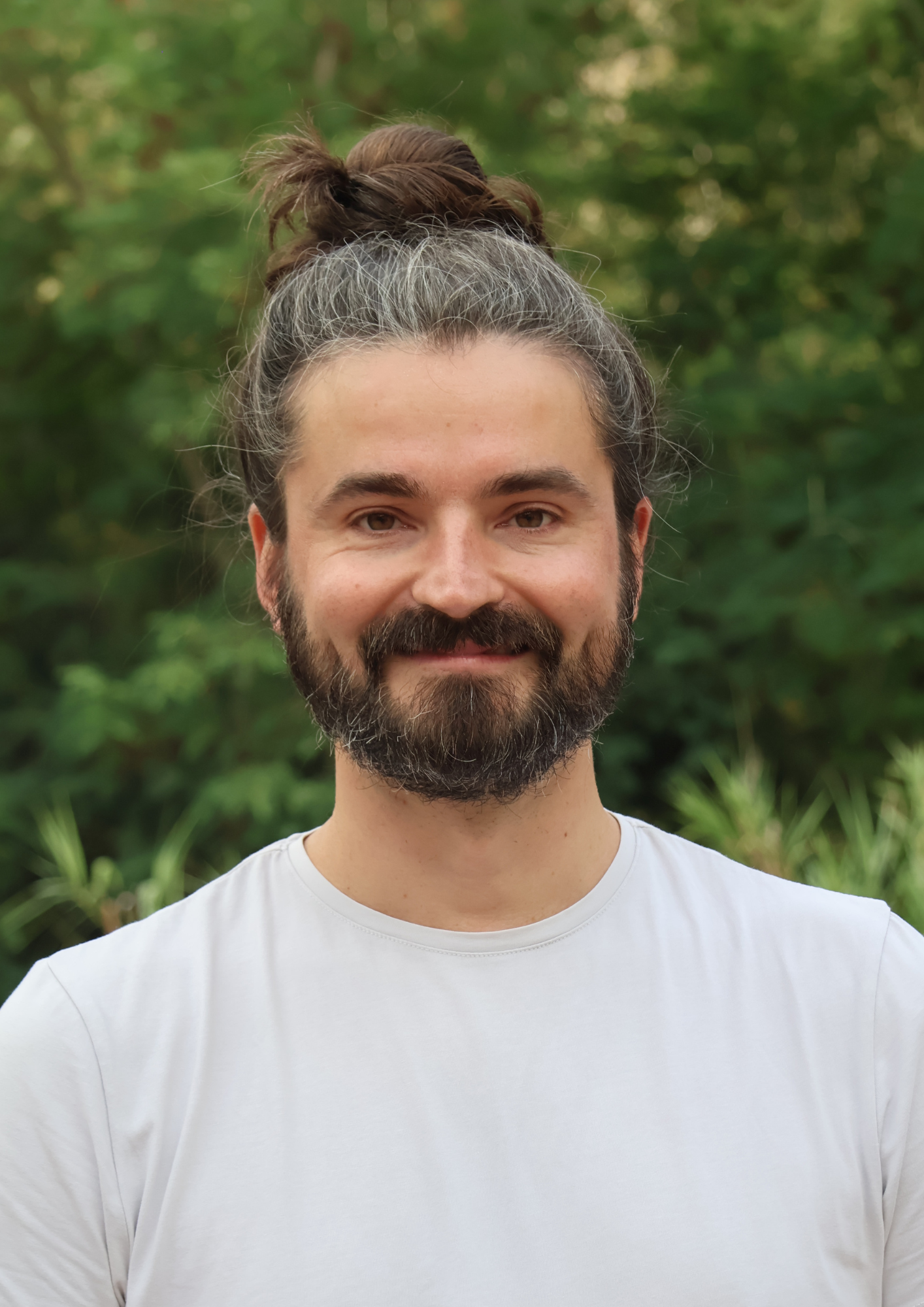
My work and life revolve around fostering environments that support healthy states, traits and spaces – within ourselves and with each other. This journey has taken me from studying the mind and brain to exploring how we collaborate and create meaningful change together to teaching at university.
My journey
Bridging Inner and Outer Worlds
In my early twenties I became extremely fascinated with the mind, the brain and existential questions. This curiosity led me to explore the mind from both the outside and the inside – or the Western and Eastern perspective.
To understand the Western (outside) perspective I studied psychology, neuroscience and philosophy and worked in academia, for example within the ReSource-Project, a large, longitudinal study on the effects of meditation at the Max-Planck-Institute for Human Cognition and Brain Science.
Exploring the Eastern perspectives I dove into the teachings of ancient contemplative traditions, especially Buddhism and Daoism, and the meditative techniques associated with them, e.g. meditation, Yoga and Qigong as well as breathwork, plant medicine and other healing modalities. The more I practiced these internal techniques the more I understood their value for individual and collective mental health and well-being.
I had the chance to combine these two perspectives on the mind, the inner and the outer, in designing and teaching an experimental inner science course at the Berlin School of Mind and Brain at Humboldt-University, Berlin.
Inner Science
I am generally fascinated by the idea of applying the scientific method and ideals that we have used so successfully in investigating and transforming the external world and applying them to our inner world. I work towards integrating the wisdom of ancient contemplative traditions with the insights of modern science and technology. The ultimate goal of this endeavour is to raise our collective level of consciousness and become more mindful, compassionate and wise as a whole. Towards this lofty goal I give talks at festivals and scientific conferences, teach courses on inner science and meditation and direct The Garden, an organisation focussed on integrating inner, interpersonal and systemic regeneration.
Creating Wholesome Spaces for Collaboration
With the goal of creating The Garden in mind I got more and more interested in organisational design and facilitation. Working in different contexts in scientific and other organisations I have time and again seen well-meaning, highly intelligent people having difficulties working together in constructive ways which I now realise was mainly due to a lack of healthy processes and structures. Seeing the need for wholesome spaces which enable joyful and efficient collaboration I trained as a coach, mediator and agile manager.
A lot of my work then focussed on supporting teams and organisations in their transition to new ways of collaboration, participation, relating and being. I am particularly focusing on psychological safety, sociocracy, self-organisation, the agile mindset, iterative-incremental workflows, decentralised organisational structures, collective decision-making, self-leadership and regenerative leadership. I apply and explore these practices in my work as a teacher and organisational coach and consultant.
I also co-founded and for three years co-directed a cooperative, self-organised coworking community in Berlin-Kreuzberg, Imago Space (formerly CoopSpace). Our goal in this coworking community is to create a space that enables community, connection and collaboration and to create a model that we would like to see in the world.
And now
Since 2025 my work has mainly moved into university. I co-teach seminars in political economy at the Otto-Suhr-Institut which treat emotion, the body and relationship as integral parts of learning. And since April 2026 I have been part of GemeinschaftsBildung, a Living Lab at the Freie Universität researching how belonging, community and cooperative learning can be built deliberately into the way a university teaches.
Useful research approaches
A useful metaphor for most of my work is the garden. I believe that if we create and tend to a wholesome social soil it is likely that beautiful people, projects and relationships grow. Below are some more research principles that I embrace.
Action research
I follow the ideal of action research which means that we seek to enable transformative change. We are taking action and doing research at the same time. These periods of action and research are followed by review and reflection. Then another more informed, updated iteration of action follows and the cycle continues.
Citizen science
I believe that we are all scientists at heart whether we already know it or not. I want to make the inner scientific mindset explicit and empower as many people as possible to explore themselves to become more content and self-efficacious. I believe that good things will come from making inner science and our research findings available to everyone.
Community
Margeret Wheatley writes: “Whatever the question, community is the answer!” This line rings truer the more time I spend in groups and in community. Much of my work is aimed at building healthy, generative social soil — conditions of trust, care and belonging in which people can grow, think and change together. This focus on community is not only an end in itself but also a means toward the end of resilience and stability, fully utilising the power of synergy and network effects.
Inner science
I see our mind as a kind of laboratory and our content of consciousness as a stream of observable data that we can learn to better notice, observe and understand in order to become more mindful, compassionate and wise. I am in line with recent findings of cognitive science telling us that both our minds and brains are highly plastic and that mental faculties, previously thought to be rather fixed, can be greatly improved with training. This seems to be the case for attention, mindfulness, metacognition, emotional states and regulation. With the refinement of these faculties comes the promise of making richer, more fine-grained observations within, to better understand our mental patterns and to ultimately emobody our highest ideals, becoming the change we want to see in the world. We want to empower as many people as possible to undergo this transformation in the most systematic, reliable and pleasant way possible. The ultimate goal is to raise our collective level of consciousness and accelerate the transition to a true consciousness culture (Bewusstseinskultur).
First-person and third-person together
Investigating states of consciousness rewards doing both at once: exploring subjective experience directly through meditation and attention training, while measuring what correlates with it from the outside. Neither picture is complete on its own, and treating subjective experience as noise rather than evidence throws away most of the data.
Researcher, participant and measuring device
Consciousness research is unlike any other kind, because the phenomenon in question is subjective. Each of us has direct access to the data inside our own mind. That makes everyone in the room a collaborating researcher rather than a subject — and it means I test everything on myself first.
Psychological safety
People need to be able to say how they feel, voice criticism, ask the stupid question and be visibly unsure. High psychological safety correlates with better mental health in teams and with greater effectiveness. I design for it deliberately rather than hoping it shows up.
Interdisciplinarity
The questions I care about do not sit inside one field. Psychology, neuroscience, philosophy, contemplative practice, systems theory, complexity science, embodiment, pedagogy, facilitation. I believe that solutions to our current problems will emerge from bringing together different disciplines and I actively seek out collaboratiors from different disciplines.
Fun and Humour
A wise person once said: ”If it is not fun it is not sustainable”. Since we are interested in sustainable change a core principle of The Garden is to enjoy ourselves and have a good time together. This goes hand in hand with the ideal of humour and especially not taking ourselves too seriously.
Selected training
Ongoing practice: I have been practicing meditation, Qigong and Taichi since my early twenties, alongside studying Buddhist and Daoist psychology and philosophy. I have attended numerous meditation retreats, and extensively explored breathwork and plant medicine and other inner technologies. These practices and the insights gained from them inform all of my endeavours.
Get in touch
If you feel like getting in contact, drop me a line.